| |
|
Home | Author Bio | Books | New Work | News & Appearances | Articles | Contact |
|
A WORD ABOUT MY
PREVIOUS BOOKS "SELLING MONEY" AND "OUTLAW BANK"
Readers who know me from "Empire of the Summer Moon" may be
surprised to discover that my previous books are quite
different--not at all the sort of American history that they
might be expecting. I wanted to add a note of explanation. For
most of my career I have been a working journalist for various
publications, especially Time Magazine and Texas Monthly. These
other books grew directly from my journalistic/magazine work. In
the case of "Selling Money," I had written a story for Harper's
magazine about my years in the banking business. The story
attempted to explain the rather dire $600 billion debit crisis
the world was then in the throes of in terms of my own career as
an international banker. The story got some national attention
and led to a book contract with Simon and Schuster (it later
migrated to Weidenfeld and Nicholson). The book was essentially
just a drawn out version of the Harper's piece. "Outlaw Bank"
was the direct product of more than twenty stories that Jonathan
Beaty and I did for Time in the early 1990s on BCCI, which was
at the time the largest financial fraud in history. In July
1991the bank was seized globally. That same month Jonathan and I
had a cover story in Time and that led directly to a contract to
write a book for Random House.
Though I delve into some history in both books, neither one
would be considered history in the way that "Empire" is. The
latter is really my first shot at writing pure history.
S.C. Gwynne |
|
|

|
|
*
Pulitzer Prize Finalist *
National Book Critics Circle Award Finalist
*
*
WINNER - Texas Book Award and the Oklahoma Book Award
*
|
|
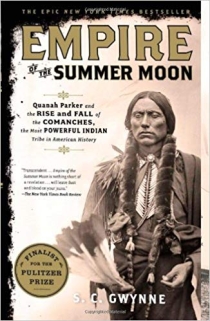
EMPIRE OF THE SUMMER MOON
By S. C.
Gwynne
|
|
S. C.
Gwynne’s Empire of the Summer Moon spans
two astonishing stories. The first traces the rise and
fall of the Comanches, the most powerful Indian tribe in
American history. The second entails one of the most
remarkable narratives ever to come out of the Old West:
the epic saga of the pioneer woman Cynthia Ann Parker
and her mixed-blood son Quanah, who became the last and
greatest chief of the Comanches.
Against
this backdrop Gwynne presents the compelling drama of
Cynthia Ann Parker, a lovely nine-year-old girl with
cornflower-blue eyes who was kidnapped by Comanches from
the far Texas frontier in 1836. She grew to love her
captors and became infamous as the "White Squaw" who
refused to return until her tragic capture by Texas
Rangers in 1860. More famous still was her son Quanah, a
warrior who was never defeated and whose guerrilla wars
in the Texas Panhandle made him a legend. |
|
|
CLICK HERE FOR REVIEWS |
|
|
|

CLICK HERE FOR REVIEWS
|
|
THE OUTLAW BANK: A WILD RIDE INTO THE
SECRET HEART OF BCCI
By S. C.
Gwynne & Jonathan Beaty
|
|
The latest chronicle of the Bank of
Credit and Commerce International (BCCI) is "about the
biggest bank fraud in the history of the world," write
the authors, reporters for Time magazine. They have
tracked the story much as Woodward and Bernstein sniffed
out Watergate. While there is some overlap between this
and two previous BCCI books (James Adams's A Full
Service Bank , LJ 3/1/92, and Mark Potts's Dirty Money ,
LJ 5/1/92), this one gives a far-ranging overview of
BCCI's origins, how it became a financial powerhouse,
and how it fell apart. Some of the new revelations
indicate a major cover-up involving the U.S. government;
there is a great deal of cloak-and-dagger activity
involving late-night meetings and anonymous high-level
government sources (one named Condor, who is reminiscent
of Deep Throat during Watergate). Given the scope of
this scandal and the ongoing investigations, more books
on BCCI are sure to be written, but this is probably the
best now available for general readers on the subject.
Previewed in Prepub Alert, LJ 11/1/92.—Richard
Drezen, Merrill Lynch Lib., New York
(c) Copyright 1993 Reed Business
Information, Inc.
|
|
|
|
| |
| |
|
|

CLICK HERE FOR REVIEWS |
|
SELLING MONEY
By S. C.
Gwynne
|
|
Gwynne's funny, often astonishing, tale
of a youth spent lending American money south of the
equator adds a much-needed dash of color to what is now
the dreary and all-too-familiar story of how bankers led
the Third World and the industrialized world alike into
the sorry mess we now know as the international debt
crisis. Furthermore, his experience as a former insider
at Cleveland Trust, a "regional' bank, enables him to
explain the perspective of banks other than the big
money-center operations that dominate finance in New
York, Chicago, and California. The big boys' activities
in Latin America and elsewhere are more publicized, but
the smaller regional banks' role in the lending boom and
the debt crisis was in many ways just as important.
Collectively, the regionals constitute a major power
bloc; they hold 43 percent of the total foreign debt
owed to our banks. (The top 15 banks have the rest.)
|
|
|
|
| |
|
|
|